The Gulf Changed Its Entry Rules 14 Times This Year: A Traveller’s Reconciliation
 Elena DarziSeptember 16, 202630 min read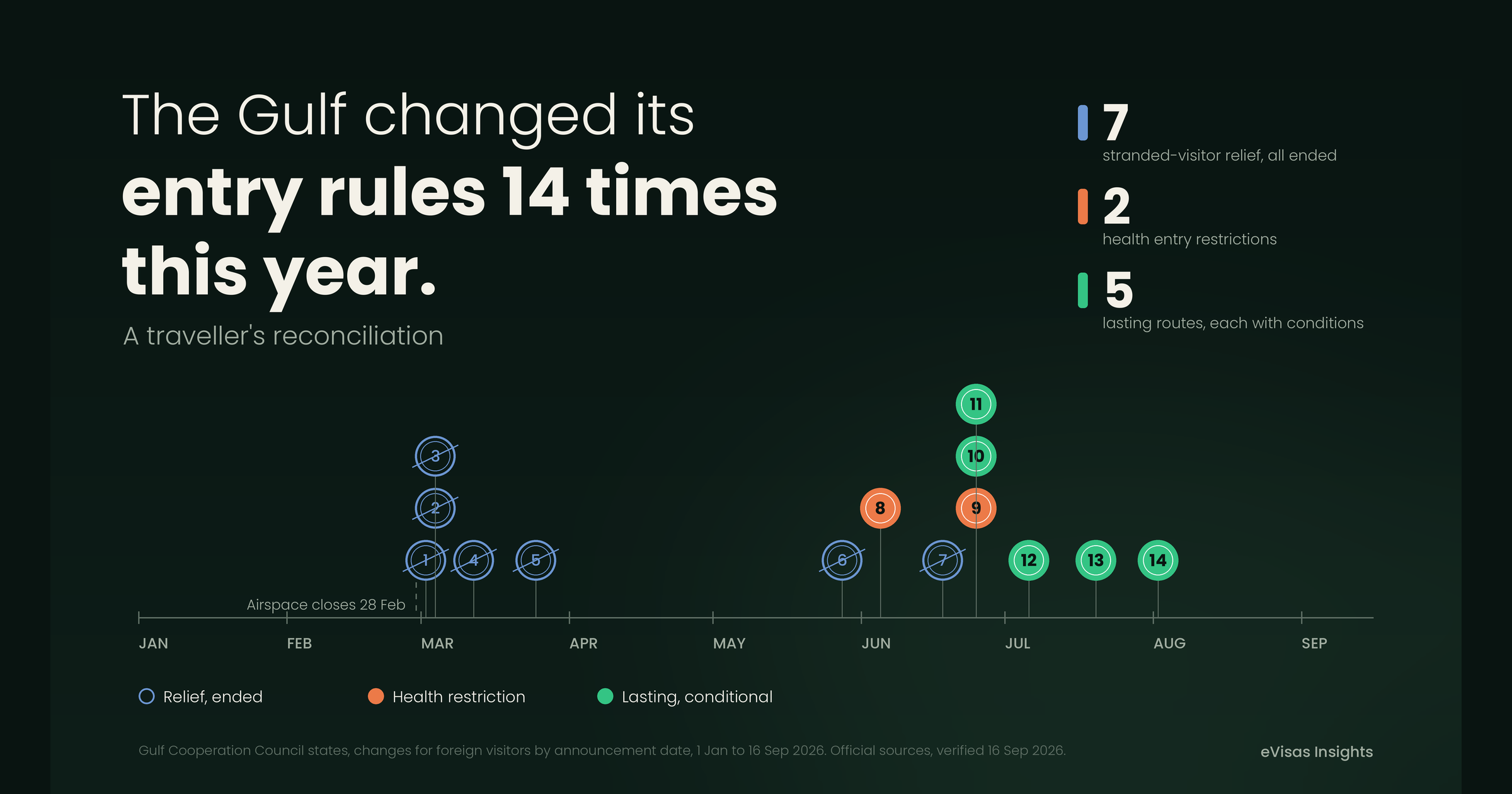
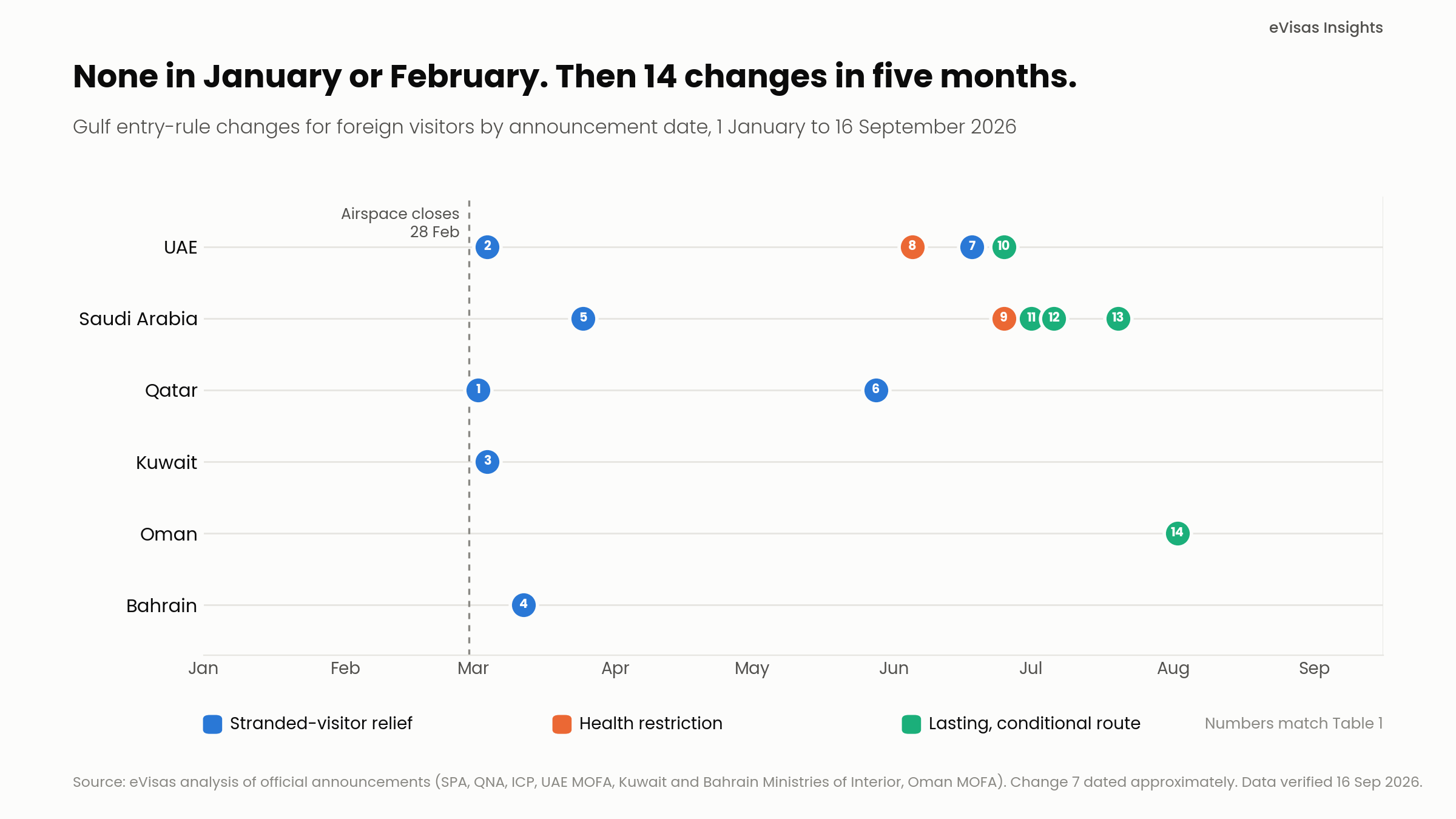
Between 1 January and 16 September 2026, the six Gulf Cooperation Council states changed the rules for foreign visitors at least 14 times. We counted only changes we could read on a government page, or in the official statement of a state news agency or ministry. Four more were reported by regional newspapers quoting official sources, and they are listed separately below.
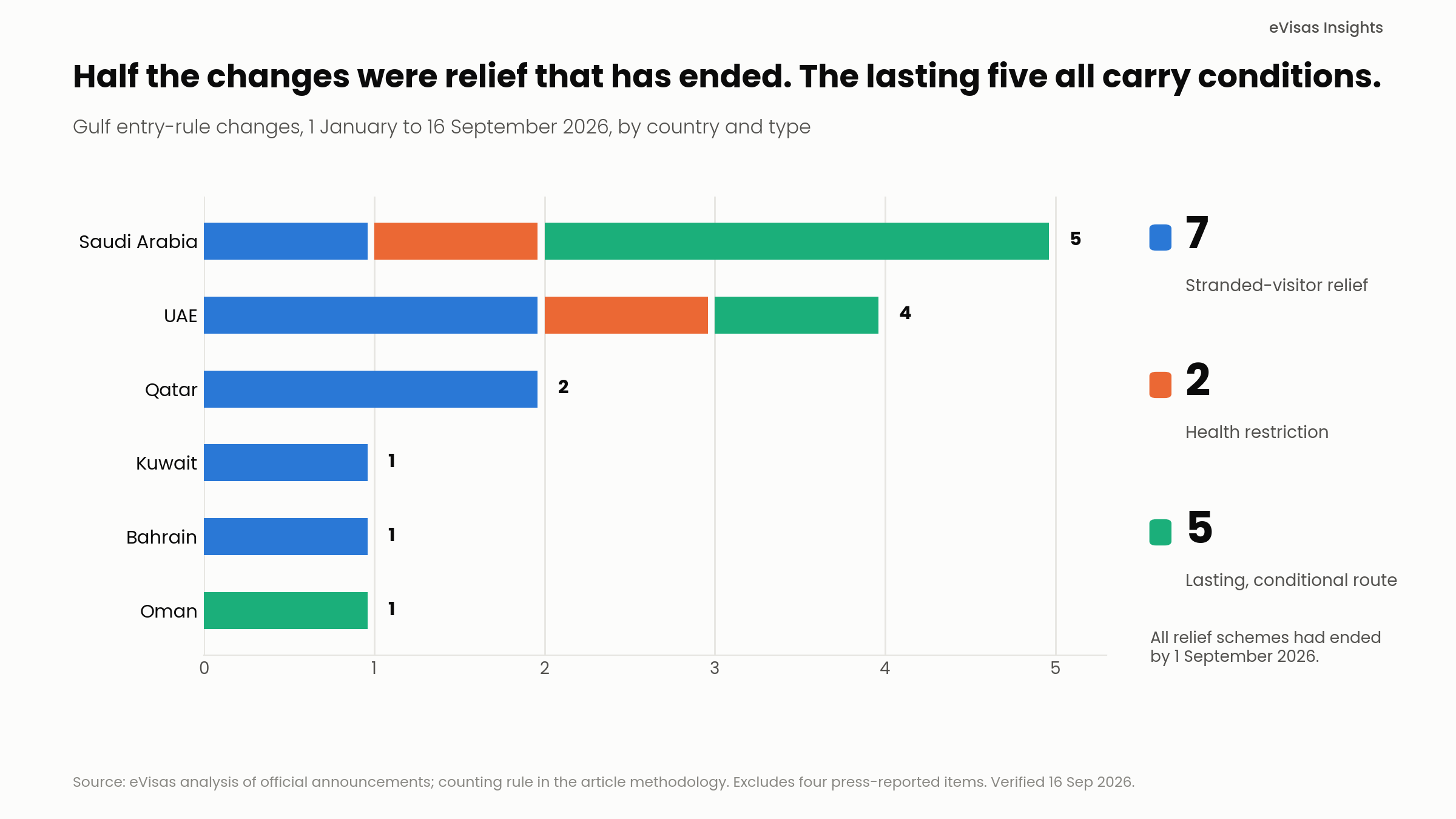
Most of those 14 changes are already behind us. Seven concerned visitors stranded when airspace across the region closed on 28 February 2026: five relief schemes, and two announcements that ended them. By 1 September all five schemes had ended. Two changes are health restrictions on travellers from three countries named in June measures on Ebola. The remaining five are lasting changes, and each one applies only to a defined group of travellers: people holding a particular residence permit, a particular passport, a particular package, or a nationality on a list that has not yet been published.
That is the pattern this article reconciles. A headline that says a Gulf state has “opened up” or “extended visas” was often true on the day it was written. On 16 September 2026, many of those headlines no longer describe the rules at the border.
The short answer
What is the current position? As of 16 September 2026:
The stranded-visitor relief schemes have ended.
Saudi Arabia’s closed on 18 April, Qatar’s on 7 June and the UAE’s final grace period on 9 July. Bahrain’s fine waiver ran until one month after its airspace reopened. Kuwait’s ministry announced, according to newspaper reports, that its automatic extensions would stop from 1 September. Standard overstay rules apply again across the region.
The lasting changes are conditional.
The UAE’s expanded visa on arrival needs a valid residence permit from a listed country. Saudi Arabia’s new Electronic Travel Authorisation is for UK passport holders only. Oman’s new 14-day tourist visa applies to nationalities the authorities designate, and that list has not been published.
The GCC unified tourist visa has not launched.
The GCC Secretary-General said in early September 2026 that it would arrive “soon”, with no date, according to press reports.
The reconciliation table
This is the complete log. Dates are as stated by the issuing authority. Where an authority gave an announcement date but no separate effective date, the table says so rather than guessing.
Table 1. Gulf entry-rule changes for foreign visitors, 1 January to 16 September 2026
Sources: Qatar News Agency for the Qatar Ministry of Interior (1, 6); UAE Federal Authority for Identity, Citizenship, Customs and Port Security (2, 10); Emirates News Agency statement, read in republication because the agency’s site blocks access (7); National Emergency Crisis and Disasters Management Authority and ICP statement, read on the Sharjah Government Media Bureau’s news service (8); UAE Ministry of Foreign Affairs (10); Kuwait Ministry of Interior (3); Bahrain Ministry of Interior (4); Saudi Press Agency for the Ministry of Interior, Public Health Authority, Ministry of Tourism and Ministry of Hajj and Umrah (5, 9, 11, 12, 13); Oman Ministry of Foreign Affairs relaying the Royal Oman Police decision published in the Official Gazette (14). All dates 2026. Verified 16 September 2026.
Reported, but not yet confirmed on an official page
These four items were reported by named newspapers quoting the ministry responsible. We could not read the original statement on a government website, in several cases because the site blocks automated access. They are not included in the count of 14.
What the 14 changes add up to
Sorting the log by what each change did produces a finding that no single announcement shows.
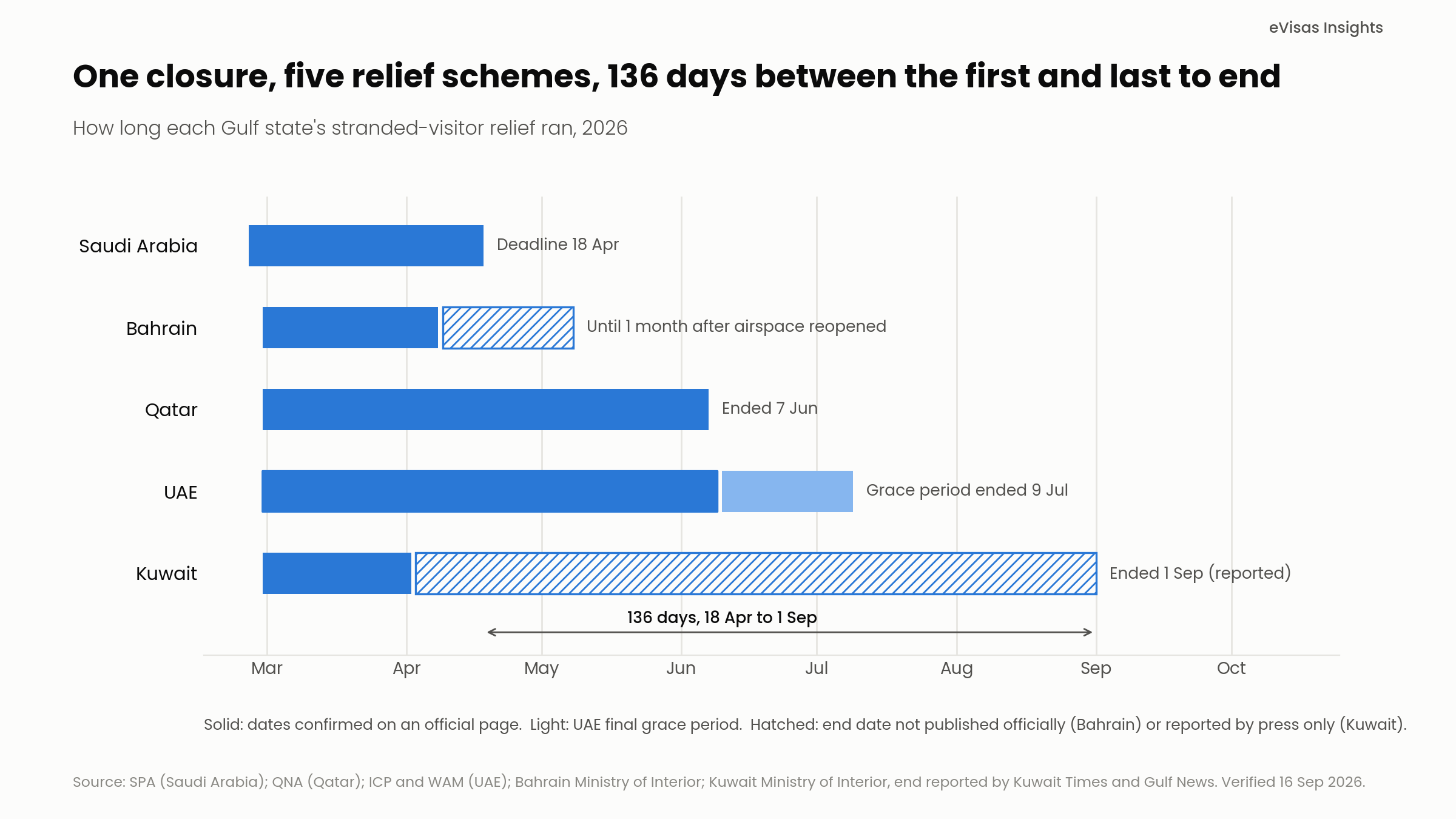
Seven changes were stranded-visitor relief, and every scheme is now over. The same event, the closure of regional airspace on 28 February, produced five relief schemes with five different designs: five announcements that opened them and two that closed them. Saudi Arabia set a fixed deadline of 18 April. Bahrain tied its fine waiver to one month after the airspace reopened. Qatar ran its extension until 7 June. The UAE waived fines and then added a final 30-day grace period ending 9 July. Kuwait extended at least once more, in April, and according to newspaper reports of its ministry’s announcement returned to normal rules on 1 September. From Saudi Arabia’s deadline to Kuwait’s reported return to normal rules on 1 September is 136 days: the same closure, with relief ending more than four months apart.
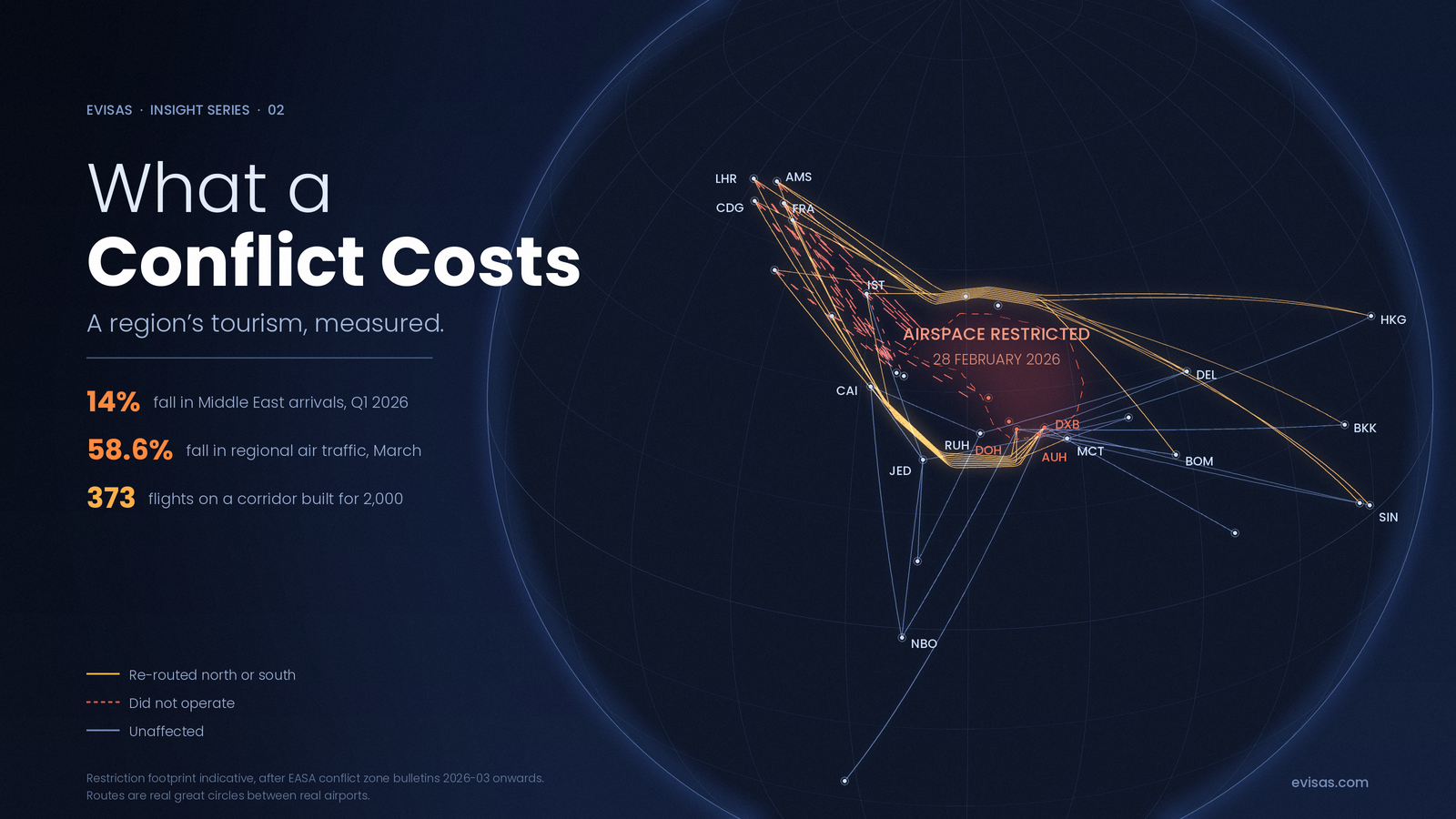
We measured what the closure itself cost the region’s tourism in our analysis of 1 September, What a Conflict Costs a Region’s Tourism, Measured. For a traveller, the spread of end dates is the practical problem. Someone who read in late April that Gulf states were extending visas for stranded visitors could have been right about Kuwait and wrong about Saudi Arabia on the same day. Anyone relying on those measures now is relying on rules that no longer exist.
Two changes are health restrictions. The UAE and Saudi Arabia both restricted entry for travellers from DR Congo, Uganda and South Sudan in June. We found no official announcement lifting either measure by 16 September 2026. Bahrain and Oman also introduced measures, reported in the regional press, and UK government travel advice for Bahrain, updated 20 August 2026, still describes Bahrain’s.
Five changes are lasting, and all five are conditional.
Each one applies only to a defined group:
1. The UAE visa on arrival requires a residence permit, not a visa, from one of eight listed countries or an EU member state.
2. The Saudi ETA is for UK passport holders, and it is still an authorisation obtained before travel.
3. The Saudi Package Visa is sold only by approved travel providers, in pilot markets the ministry has not named.
4. The multiple-entry Umrah visa requires a Nusuk package and Umrah permit for every visit, and cannot be activated during the Hajj season.
5. Oman’s new 14-day tourist visa applies to nationalities the authorities designate, and the list has not been published.
Country by country: the position today
United Arab Emirates
What changed in 2026. Four changes. The UAE’s airspace response was a fine waiver rather than an extension: from 4 March, the Federal Authority for Identity, Citizenship, Customs and Port Security (ICP) cancelled overstay fines for people who could not leave. That waiver ended with a final 30-day grace period from 10 June to 9 July. In June the UAE also restricted entry for travellers from three countries named in its Ebola precautions, and expanded its visa on arrival to six more nationalities.
Who the visa on arrival change actually helps. The expansion, announced by the Ministry of Foreign Affairs on 25 June, covers nationals of Indonesia, Vietnam, Thailand, the Philippines, Kenya and South Africa, who join Indian nationals on the route. The condition is the important part. The traveller must hold a valid residence permit from the United States, an EU member state, the United Kingdom, Singapore, Japan, South Korea, Australia, New Zealand or Canada. A visit visa for one of those countries does not qualify under this route. A 14-day visa can be extended once in the country; a 60-day visa is single entry and cannot be extended.
So a Filipino citizen living in Canada on a residence permit gains a new option. A Filipino traveller flying from Manila on a tourist trip does not.
The position today. Whether a visa must be arranged before travel depends on nationality and residence, so check your own passport against the official list. Tourist visas come in several lengths, single or multiple entry. Visit and tourist stays can be extended in the country through ICP or, in Dubai, the General Directorate of Residency and Foreigners Affairs, up to 120 days in total for tourism according to ICP. Since the grace period ended on 9 July, overstays attract daily fines. Passports should be valid for six months from arrival.
Travelling to the UAE? Depending on your nationality and residence, you may need a visa arranged before you fly. eVisas checks your eligibility, documents and photo before anything is submitted, so we can pick up errors before the application is filed. Check your UAE visa options
Saudi Arabia
What changed in 2026. Five changes in the count, more than any other Gulf state. Three are new routes, one was stranded-visitor relief, and one is a health restriction.
The relief measure, announced on 25 March, covered visit, Umrah, transit and final exit visas that expired from 25 February. Holders could extend through their host with fees, or leave directly without late fines. It carried a firm deadline of 18 April, and standard rules have applied since.
The new routes are narrower than their headlines:
1. An ETA for UK passport holders, from 1 July, available alongside the existing tourist eVisa. It allows multiple entries for tourism, business and short-term study, up to 180 days in total. It does not permit work, residence or Hajj. The Saudi Press Agency describes the total as falling within one year; the UK government’s travel advice gives a validity of 730 days. Travellers should read the conditions on their own authorisation.
2. A Package Visa pilot, from 6 July. The tourist visa is sold as part of a package of return flights and licensed hotel accommodation, only through approved travel and tourism providers, and only in pilot markets the ministry has not named.
3. A multiple-entry Umrah visa, from 20 July. It is valid for 365 days with up to 90 days’ total stay. Each visit requires a Nusuk package from an approved provider and a Nusuk Umrah permit before arrival, and the visa cannot be activated between 1 Dhu al-Qi’dah and 13 Dhu al-Hijjah. These Islamic calendar dates move each year against the Gregorian calendar and are confirmed by the Saudi authorities.
The position today. The standard tourist visa allows multiple entries with up to 90 days in total within a year, according to the UK government’s travel advice. No tourist visa, ETA or visa waiver permits Hajj. The Umrah season for 1448 opened on 31 May 2026, and the Ministry of Hajj and Umrah has set 23 March 2027 as the last date of entry. Passports should be valid for six months.
Travelling to Saudi Arabia? Tourism, business and family visit visas each have their own conditions and document requirements. eVisas reviews your application in full before it is filed and keeps you updated until a decision is issued. Check your Saudi Arabia visa options
Qatar
What changed in 2026. Two changes, which open and close one measure. On 2 March the Qatar News Agency announced that the Ministry of Interior had extended all expired or expiring entry visas by one month, backdated to 28 February, with no fees and no application needed. On 28 May the ministry announced that the extension would end on 7 June. From that date, standard visa validity, fees and overstay penalties apply, and visitors must renew within the normal periods or leave.
The position today. Entry routes depend on nationality: some nationalities receive visa-free entry, and others apply through the Hayya platform. Visitors extend through the Ministry of Interior before their permitted stay ends. UK government travel advice notes that health insurance from a provider registered with Qatar’s Ministry of Public Health is required for stays of more than 30 days, bought before travel.
Kuwait
What changed in 2026. One change in the count, and two more reported. On 4 March the Ministry of Interior announced that it had automatically extended all types of visit visa by one month from 28 February, and gave residents stranded abroad an automatic absence permit. Arab Times reported a further one-month renewal in April. On 20 August, according to Kuwait Times and Gulf News, the ministry announced a return to the rules in place before 28 February, effective 1 September.
The position today. Most visitors need a visa, applied for through the Ministry of Interior’s Kuwait Visa platform or, for some nationalities, on arrival. The platform describes a tourist visa allowing a stay of up to 90 days and a family or business visit visa allowing 30 days. Visitors should expect to show a return ticket and accommodation details.
Oman
What changed in 2026. One change in the count. On 2 August 2026, Oman’s Official Gazette published a Royal Oman Police decision adding a new 14-day tourist visa to the regulations of the Foreign Residence Law, effective the next day. The visa can be converted to another tourist visa before it expires, with conditions. It applies to nationals of countries designated by the competent authority, and on 16 September 2026 that list had not been published.
This is not the same as Oman’s visa-free entry. Oman already allows nationals of listed countries to enter without a visa for 14 days, some of them only if they also hold a visa or residence permit from specified countries. According to Oman’s Ministry of Foreign Affairs, that visa-free stay cannot be extended or converted into a residence visa. Some reports in August described the new visa as “visa-free entry for 100 countries”. It is not.
The position today. The visa-free stay is 14 days, for listed nationalities only, with no extension or conversion. Travellers staying longer, or whose nationality is not on the list, need a visa before travel. At the border, travellers may be asked for a return or onward ticket, a hotel booking and travel health insurance, and passports should be valid for six months.
Staying in Oman longer than 14 days? The visa-free window cannot be extended, so a longer stay needs a visa in place before you travel. eVisas checks your passport, dates and documents before your application is filed. Check your Oman visa options
Bahrain
What changed in 2026. One change in the count, and one reported. On 12 March, the Nationality, Passports and Residence Affairs under-secretary announced that visit visa holders in Bahrain whose permitted stay ended on or after 28 February would not be fined until one month after the airspace reopened, and that visit visas for people unable to travel would be extended by three months. That relief has ended. In May, Khaleej Times reported a suspension of entry for non-Bahraini travellers from three countries affected by Ebola. UK government travel advice, updated 20 August 2026, still says non-Bahraini travellers who have been in affected countries in the past 30 days will not be admitted.
The position today. No 2026 change to Bahrain’s standard visitor routes was found. The eVisa is issued for a short default period of two weeks, with longer visit visas available. Travellers may be asked for proof of onward or return travel and accommodation, and passports should be valid for six months.
Travelling to Bahrain? Choosing between a two-week visa and a longer visit visa depends on your dates. eVisas helps you pick the right visa and checks your documents before submission. Check your Bahrain visa options
Neighbouring: Jordan
Jordan is not a Gulf state, but it borders the region and changed several visitor rules over the past year.
1. Police registration for stays over 14 days. Since 1 October 2025, according to both the US Embassy in Amman and UK government travel advice, some foreigners staying longer than 14 days must register at a police station and give biometrics. UK government travel advice, updated 10 September 2026, says tourists, pilgrims, transit visa holders and annual residents are exempt. The US Embassy describes the exemptions more narrowly, so travellers planning a stay of more than 14 days should confirm before travel.
2. A longer stay at entry. On 8 January 2026, Jordan’s Interior Minister announced that visitors on a visa on arrival or eVisa would receive three months’ stay at entry, replacing one month plus an extension at a police station. The announcement was reported by CNN Arabic quoting the ministry, and the UK government’s travel advice, updated 10 September 2026, now describes the visa on arrival as valid for three months with online extension available. The same advice still lists the 14-day registration rule, so the longer stay does not appear to have removed it.
3. A health restriction. In May 2026, Khaleej Times, citing Jordan’s state news agency, reported that Jordan suspended entry for arrivals from DR Congo and Uganda. We could not confirm the current status on an official page.
Travelling to Jordan? Stay length, entry type and any obligations after arrival depend on your visa and your plans. eVisas reviews your eVisa application in full before submission and can advise on what to expect after arrival. Check your Jordan visa options
How the rules compare today
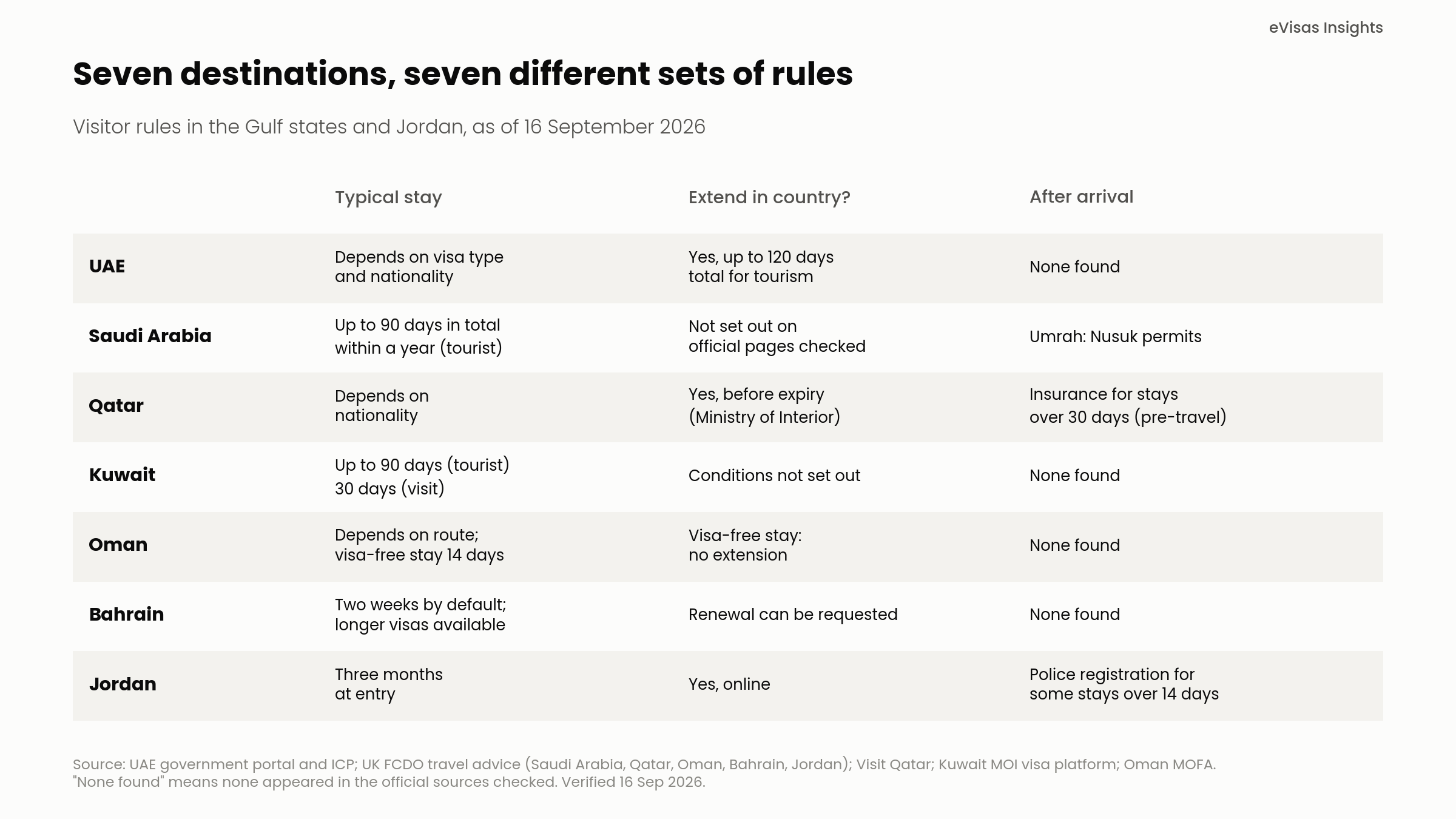
Table 2. Visitor rules in the Gulf states and Jordan, as of 16 September 2026
Sources: UAE government portal and ICP; UK government travel advice for Saudi Arabia, Qatar, Oman, Bahrain and Jordan; Visit Qatar; Kuwait Ministry of Interior visa platform; Oman Ministry of Foreign Affairs; US Embassy Amman. Table 2 does not list health checks, such as Jordan’s HIV test for stays over 30 days noted in UK travel advice. Verified 16 September 2026. “None found” means no requirement appeared in the official sources checked; it is not a confirmation that none exists.
Six common misreadings
1. “Gulf states are extending visas for stranded travellers.” They were. Every relief scheme we found has ended, the last of them in Kuwait on 1 September according to newspaper reports of the ministry’s announcement. Standard overstay rules apply across the region.
2. “The UAE now gives visa on arrival to Filipinos, Indonesians, Thais, Vietnamese, Kenyans and South Africans.” Only to those who hold a valid residence permit from one of the listed countries. Holding a visa for those countries is not enough under this route.
3. “Oman is now visa-free for 100 countries.” Oman’s visa-free list predates 2026, and that 14-day stay cannot be extended. The August 2026 change is a separate 14-day tourist visa whose eligible nationalities had not been published by 16 September.
4. “Saudi Arabia launched a new visa platform this year.” The unified platform launched in January 2024. The 2026 changes were the UK ETA, the Package Visa pilot and the multiple-entry Umrah visa.
5. “A multiple-entry Umrah visa means you can fly in whenever you like for a year.” Each visit still needs a Nusuk package and an Umrah permit before arrival, and the visa cannot be used during the Hajj season.
6. “One visa now covers all six Gulf states.” Not yet. The GCC unified tourist visa has been approved in principle since 2023, but on 16 September 2026 it had no launch date. A pilot of pre-departure clearance between the UAE and Bahrain, launched in February 2026, is for GCC citizens, not for foreign visitors, according to press reports.
Why a managed application still matters in a year like this
The research shows a region whose rules moved 14 times in under nine months, with a further four changes reported. Most of those changes were temporary, and the lasting ones carry conditions that are easy to misread from a headline. The problem for a traveller is not a lack of information. It is information that was correct when published and is not correct now.
That is where a checked application earns its place. For the UAE, Saudi Arabia, Oman, Bahrain and Jordan, the question is rarely only “do I need a visa?” It is which visa fits the dates, how long it permits, whether it can be extended, and what the traveller must do after arrival. eVisas reviews every application for completeness and accuracy before it is filed, checks documents and photos against the destination’s requirements, and keeps travellers updated until a decision is issued. We do not decide applications; the government authority does. What we do is check that an application is complete and consistent before it is filed.
Frequently asked questions
Answers verified 16 September 2026. Gulf entry rules change often; check the date before relying on an answer.
How many times did Gulf states change their entry rules in 2026?
At least 14 times between 1 January and 16 September 2026, counting only changes confirmed on a government page or in a state news agency statement. Four further changes were reported by regional newspapers quoting official sources.
Are Gulf visa extensions for stranded travellers still in place?
No. Saudi Arabia’s relief ended on 18 April 2026, Qatar’s on 7 June and the UAE’s final grace period on 9 July. Kuwait’s ministry announced that its automatic extensions would end from 1 September, according to newspaper reports. Standard overstay rules now apply.
Who is eligible for the UAE’s expanded visa on arrival?
Since June 2026, nationals of Indonesia, Vietnam, Thailand, the Philippines, Kenya and South Africa who hold a valid residence permit from the US, an EU member state, the UK, Singapore, Japan, South Korea, Australia, New Zealand or Canada. They join Indian nationals, whose route has its own conditions. Travellers without a qualifying residence permit need a visa arranged in advance.
What is Oman’s new 14-day tourist visa?
A tourist visa added to Oman’s Foreign Residence Law regulations from 3 August 2026. It applies to nationals of countries the authorities designate, and that list had not been published by 16 September 2026. It is separate from Oman’s older 14-day visa-free entry for listed nationalities, which cannot be extended. Longer stays need a visa.
Has the GCC unified tourist visa launched?
No. On 16 September 2026 no launch date had been announced. The GCC Secretary-General said in early September that it would launch soon, according to press reports.
Do UK citizens need a visa for Saudi Arabia?
Yes, UK travellers need permission to enter before travel. Since 1 July 2026 they can apply for a Saudi Electronic Travel Authorisation as well as the existing tourist eVisa. The two have different conditions, and neither allows Hajj or work.
Do I need to register with the police in Jordan?
Since 1 October 2025, some foreigners staying longer than 14 days must register at a police station. UK government travel advice says tourists, pilgrims and transit visa holders are exempt; the US Embassy in Amman describes the exemptions more narrowly, so confirm before a stay of more than 14 days.
Conclusion
The Gulf’s year in entry rules is not a story of doors opening. It is a story of emergency measures that came and went on five different timetables, two health restrictions, and five new routes that each apply to a defined group. The traveller who reads one headline gets one country, on one date, for one group of people.
We will keep this change log current. The next scheduled review is 16 December 2026, and any change confirmed before then will be added with its date and source. If a figure here is wrong, we will correct it visibly with a dated note.
Planning a trip to the Gulf or Jordan? Rules change often and the conditions matter. eVisas checks your application in full before it is submitted, for the UAE, Saudi Arabia, Oman, Bahrain and Jordan.
Ready to get started?
How we counted
We counted published government decisions, announced or taking effect between 1 January and 16 September 2026, that changed who may enter a Gulf state as a visitor, how long they may stay, or what they must do, and we read each one on an official page or in an official statement on 16 September 2026. Seasonal calendars, operator sanctions, residence and work rules, and items reported only by the press were left out; the full method and its limits follow.
Full methodology and limitations
What we counted. A change is a published government decision, announced or taking effect between 1 January and 16 September 2026, that altered who may enter a Gulf Cooperation Council state as a foreign visitor, how long they may stay, or what they must do before or after arrival. The start and end of a temporary measure count separately where they were announced separately, because each changed what a traveller had to do. Where a single announcement set its own end date, as Saudi Arabia’s did, it counts once.
What we excluded. Annual seasonal calendars that repeat every year, such as Hajj period restrictions and Umrah season dates. Sanctions on operators rather than rules for travellers, such as Saudi Arabia’s suspension of 21 Umrah companies on 13 June 2026. Reminders of existing rules. Changes to residence and work permits. Changes that took effect in 2025. Changes we could not trace to a named government body.
How we verified. Every counted change was read on a government website, an official portal, or in a state news agency’s own statement, on 16 September 2026. Two UAE items (7 and 8) were read as verbatim republications of official statements, because the Emirates News Agency site blocks automated access. Where an official website blocked access, we used UK government travel advice as a dated official reference and say so. Items read only in newspapers are listed separately and not counted.
What this cannot show. Several Gulf government websites block automated access, and some ministries publish announcements only on social media or in Arabic. A change announced only in those places may be missing. Stay lengths and extension rights vary by nationality and visa type, and Table 2 describes the typical case, not every traveller. No fees or penalty amounts are given; check them with the issuing authority.